Best Practice
Impact of SBAR

Some time back I wrote a blog post on using SBAR (Situation-Background-Assessment-Recommendation) as a technique to assist organize your shift change report. First deployed by the U.S. Navy to scale back miscommunication, this tool is becoming increasingly common in healthcare settings. It has been theorized that using a standardized approach equivalent to SBAR creates a “common language” amongst healthcare professionals and subsequently reduces communication errors and will even influence our behavior. A recent study published within the journal examined the potential impact of SBAR on nurses’ every day activities.
The researchers interviewed nurses, nurse managers, and physicians at two hospitals where implementation of the SBAR protocol was within the early stages. Analysis of the information revealed two findings: first, most viewed SBAR solely as a way of standardizing communication, and second, that SBAR actually has “more far-reaching effects than just being a communication tool.”
So what are these “far-reaching effects”?
1. Development of flowcharts – SBAR facilitated the event of flowcharts that help nurses make intuitive decisions.
2. Contribution to the buildup of social capital – The common language of SBAR serves as a way of integrating nurses into the organization.
3. Providing legitimacy – common practice also helps individuals gain credibility.
4. Change of logic – SBAR supports the transition from individual autonomy to standardization and formalization of the nursing occupation.
Interesting findings! This reasonably easy tool has far-reaching implications – for our individual practice and our occupation. If we communicate more effectively, make decisions more easily, and develop into integrated into the organization as a reputable member of the health care team as a nursing skilled, won’t this ultimately lead to higher patient care and higher outcomes?
Reference: Vardaman, J. M., Cornell, P., Gondo, M. B., Amis, J. M., Towensend-Gervis, M., Thetford, C. (2012). Beyond communication: the role of ordinary protocols in a changing health care environment. 88-97.

A nurse’s lesson on grace

Teachers and doctors lose the power to self-regulate. What is the chance?

From the nightingale’s oath to the nurse’s oath

Global Fund Approves Emergency Financing for Malaria Prevention to Secure Ebola Response in Democratic Republic of the Congo – Press Releases

Global Fund approves emergency funding to guard HIV and TB services in Venezuela after earthquakes – press releases

Global Fund Board Makes Strategic Decisions to Adapt to the Changing Global Health Landscape – Press Releases

Celebrating nurse educators and all nurses on International Nurses Day 2026 – Nursing Education Network

5 books that may help at work at work
Global Fund approves emergency funding to guard HIV and TB services in Venezuela after earthquakes – press releases
Global Fund Approves Emergency Financing for Malaria Prevention to Secure Ebola Response in Democratic Republic of the Congo – Press Releases
From the nightingale’s oath to the nurse’s oath

Global Fund Celebrates 20 Years of Transformative Partnership with Unitaid to Increase Access to Health Innovation – Updates
-
 Education6 months ago
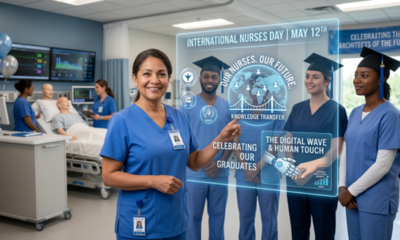
Celebrating nurse educators and all nurses on International Nurses Day 2026 – Nursing Education Network
-
 Well-Being2 years ago
5 books that may help at work at work
-
 Global Health4 months ago
Global Fund approves emergency funding to guard HIV and TB services in Venezuela after earthquakes – press releases
-
 Global Health4 months ago
Global Fund Approves Emergency Financing for Malaria Prevention to Secure Ebola Response in Democratic Republic of the Congo – Press Releases
-
 Best Practice4 months ago
From the nightingale’s oath to the nurse’s oath
-
 Global Health4 months ago
Global Fund Celebrates 20 Years of Transformative Partnership with Unitaid to Increase Access to Health Innovation – Updates
-
 Education4 months ago
Teachers and doctors lose the power to self-regulate. What is the chance?
-

 Best Practice5 months ago
Beyond community services: common cleanliness gaps in patient care